
The Thinker-Feeler Divide
Thinking about: Thinking more and better

In these posts I’ve introduced the notion of Thinkers, written with a capital T. A Thinker is someone who habitually engages in open-minded critical thinking, who consciously engages in evidence-based reasoning to reach their conclusions. In this post, I want to introduce the notion of Feelers, written with a capital F. They are people who habitually feel rather than think their way to conclusions. They are people who, metaphorically speaking, rely on their heart and gut rather than their head.
At this point, an obvious question arises. In my previous two posts, I disparaged both pigeonholing and black-and-white thinking. Isn’t this what I am doing, though, in dividing humanity into Thinkers and Feelers? Not really.
I introduce the notion of Feelers so I can present the concept of an intellectual spectrum. At its leftmost endpoint, we find pure Feelers who exclusively feel their way to conclusions, and at its rightmost endpoint we find pure Thinkers who exclusively think their way.* (You might be wondering whether such people actually exist; more on this in a moment.)
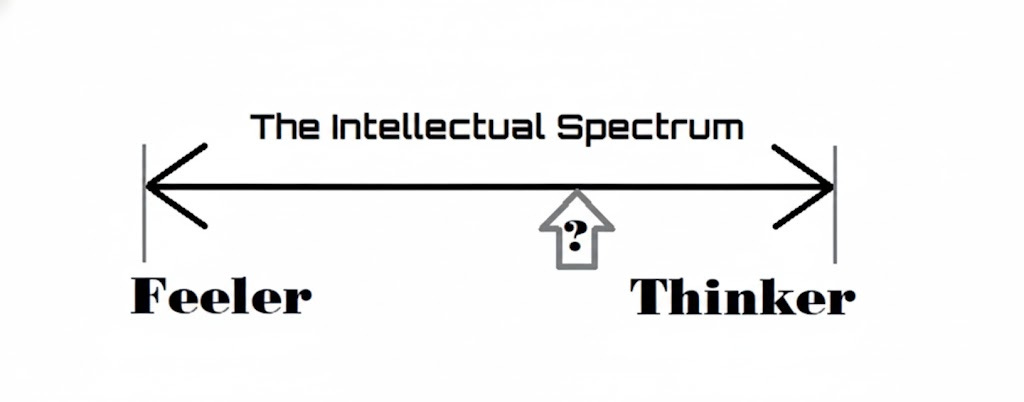
The bulk of humanity can be placed somewhere in the middle of the spectrum. Take a moment to consider the people you either know or know about, including friends, relatives, politicians, social media influencers, and the like. Some clearly belong somewhere on the left side, and others clearly belong somewhere on the right. In some cases, when considering two people, it will be clear that one should be placed to the left of the other. Indeed, I would be comfortable placing [insert the name of a prominent contemporary politician here] to the left of philosopher Bertrand Russell.**
In playing this game of “pin the person on the intellectual spectrum,” you will realize that the placements are more subjective than objective. There isn’t really a way to measure their thinking-to-feeling ratio. Furthermore, people can be intellectual hybrids, in the sense that they are Thinkers with respect to some subjects and Feelers with respect to others. A physicist who is a Thinker with respect to science, for example, might be a Feeler with respect to politics. There will also be differences in how emotional people are when they feel their way to a conclusion and how rational they are when they think their way. Furthermore, with the passage of time, people’s position on the spectrum can shift. For example, a person on the right side of the spectrum might slide leftward as a result of succumbing to a drug addiction.
Now that you have explored the intellectual spectrum by pinning other people to it, try pinning yourself. Reflect on how you form beliefs and make decisions. Does your head in fact play the dominant role, or is it your heart and gut? If you fancy yourself to be a Thinker, are you a selective Thinker who thinks their way to conclusions in some domains and feels their way in others? And if you think your head is in charge, how often is it sidetracked or even hijacked by your heart or gut?
The intellectual spectrum I have proposed is bounded, as we have seen, by pure Feelers and pure Thinkers, but do such people actually exist? I doubt that there are any pure Thinkers. Because of our evolutionary past, an emotional component is wired into us and will always affect the operation of our rational component.
In case you are wondering, although I fancy myself as being far to the right on the intellectual spectrum, I am by no means a pure Thinker. I count as a Thinker, inasmuch as I habitually engage in open-minded critical thinking and consciously engage in evidence-based reasoning to reach my conclusions. I do not count as a pure Thinker, though, because my emotions do have an impact on my thinking. And having confessed this, another confession is in order: I wouldn’t want it any other way. I very much appreciate my emotional side. In particular, I appreciate the way my eyes well up when I pause to consider what a sad place, what a beautiful place, and what a sadly beautiful place our world is. At the same time, I appreciate the role clear-headed thinking plays in helping me make sound decisions. I likewise appreciate the role evidence-based reasoning plays in allowing me to fill my mind with true beliefs so I can stay grounded in reality.
Although I doubt that pure Thinkers exist—and pity them if they do!—I am convinced that pure Feelers exist. In fact, I used to be one, as did you. I am referring to our infancy, when we were ruled by our heart and gut. As we became toddlers, our reasoning ability improved, and we started sliding toward the right on the intellectual spectrum. Another thing to realize is that as we age, there is a danger that, no matter how far to the right we are on the intellectual spectrum, we may, as a result of dementia, start sliding toward the left. We might therefore revert back to the pure Feelers that we started out as. It’s a sobering thought—but such is life.
My goal in this substack is to show people how to think more and better so they can move toward the Thinker end of the intellectual spectrum. Even though they never arrive at the pure Thinker endpoint, their progress toward it can have a positive impact on their life and perhaps on the society in which they live.
*My use of “left” and “right” has nothing to do with the political notion of left and right. My choice of endpoint labels was arbitrary; switching them wouldn’t have made a significant difference. And allow me to end this note with a clarification: Neither the political left nor the political right has a monopoly on Thinkers; indeed, across the political realm, Feelers abound.
**Back in the 1970s, Russell’s writings played a prominent role in my decision to become a philosopher. And by the way, although I have no problem classifying Russell as a Thinker, it is also clear to me, having read his autobiography, that he wasn’t a pure Thinker.
Capital, my friend. Think through your emotions and feel through your thoughts. You article moved me to comment, but made me think objectively of the need for the feel-think balance in being human.
I wonder which end of the spectrum elicits more animal rights activists and vegans. The people who study the evidence of the atrocities committed, or the ones who just feel awful about any animals suffering. I reckon it's pretty scattershot.