
Your Brain Is a Biological Computer

Author’s note: In addition to publishing new posts weekly, I periodically republish “evergreen content”—articles that focus not on current events but on why we think the way we do, as well as on how we can think more and better than is presently the case. Today’s post was originally published on July 27, 2025. Enjoy!
In my previous post, I explained how, according to evolutionary biologists, our ancestors gained the ability to experience emotions, and sometime later gained the ability to reason. I also explained how our rationality, rather than displacing our emotions, joined them. As a result, we humans are hybrid creatures. We have both an emotional and a rational component, and they can be at odds with each other.
Ask a neuroscientist to explain human irrationality, and they will introduce us to neurons, also known as nerve cells. These cells have a curious structure. Whereas most cells are roughly spherical or cuboidal, neurons have a cell body from which many “branches” protrude. One of them is the axon, which sends electrical signals to other neurons. It can subsequently split into thousands of axon terminals. Besides this axon branch, there are dendrites, maybe thousands of them, which receive signals from other neurons.
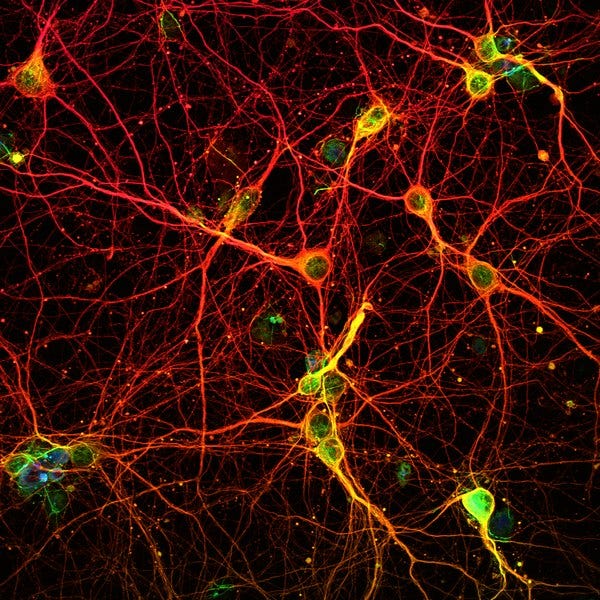
Most neurons, branches included, are less than a millimeter long, but the neurons that carry signals from the base of your spinal cord to your toes might be a meter long. Your brain is estimated to have 86 billion neurons, most of which have been with you since birth. That number, however, is likely to decline as you age, and if you fall victim to Alzheimer’s, the decline can be precipitous.
Neurons link their axons and dendrites to form networks. It is this “biological wiring” that makes thought possible. Although the operation of this “biological computer” is incredibly complex, no magic is involved, nor is there a supernatural element. What happens is bound by the laws of chemistry and physics.
Before moving on, a comment is in order. It is astonishing that purely physical processes could give rise to mental events. Indeed, I would regard this as one of the three great mysteries of the universe. The other two: Why does the universe exist—why, in other words, is there something rather than nothing? And given that the universe does exist, why does it have the physical laws it has, and why do the physical constants employed by those laws have the exact values that they do?
The connections in a neural network can change, with new connections forming and old connections being broken. Amazingly, your beliefs and memories are somehow “stored” in these connections. This means that a neurological wizard—who had a thorough understanding of the function of individual connections and the ability to alter them—could, by fiddling with individual neurons, plant beliefs and memories in your mind, as well as alter or even erase them.
It is instructive to compare human brains with cell phones. These last are remarkable devices. Right now, in my left pocket, I have vastly more computing power than was present on the entire University of Michigan campus when I set foot there in 1970. My phone can do remarkable things all by itself: Even though it is on airplane mode, it can treat me to a movie. Connect it to the internet, though, and its power is astonishing. Do I want to know what the weather is like atop Mount Everest? The answer is a click away. Have I grown curious about the sequence of nucleotides in the genome of the COVID-19 virus? No problem.
Cell phones do their “thinking” not with neurons but with 10–20 billion transistors. (The exact number depends on the model.) Whereas no two neurons are identical, the transistors in a cell phone are as identical as technology can make them. These transistors are connected to form integrated circuits. Whereas a single neuron can link up with thousands of others in a neural network, each transistor in an integrated circuit will be directly connected to only a few other transistors.

The engineers who design and manufacture integrated circuits are careful to insulate them from the outside world by encapsulating their circuitry in a plastic, ceramic, or metal package. When other engineers use those integrated circuits in cell phones, they add additional protection in the form of the cell phone case. These cases are not only watertight; they are “beertight”! (That said, I would discourage readers from dunk testing their phones!)
It hasn’t always been this way. In the early 2000s, my son somehow managed to drop his cell phone into an oversized cup of lemonade. Despite our subsequent efforts to revive the phone, the encounter with lemonade turned out to be digitally fatal.
Evolutionary processes haven’t similarly shielded your neurons; indeed, just the opposite. They are bathed in cerebrospinal fluid, the chemical composition of which can change from minute to minute. Your brain’s hypothalamus, for example, can produce oxytocin, also known as the “love hormone.” Its presence in your cerebrospinal fluid can affect the social decisions you make. The hormones produced by the adrenal glands atop your kidneys can make their way to your brain, which will respond to their presence by transitioning into a hyper-alert state. By causing you to focus your attention on your immediate circumstances, they can inhibit your ability to engage in abstract thinking.
The drugs you consume can also affect your thinking. Suppose you ignore my advice not to dunk your cell phone in beer, and when it survives the test, you celebrate by downing the beer. Your thinking will subsequently be affected, and if you continue the celebration with more beer, you might lose the ability to compose a meaningful sentence. Your thinking will be affected in a different manner if instead of drinking beer, you have a cup of coffee. The addition of caffeine to your cerebrospinal fluid will lubricate your thought processes. Drink ayahuasca, though, and you will experience hallucinations.
In my previous post, I talked about the ongoing debate between emotion and reason: Your emotions might push you to do something, and in response, your reason might try to talk you out of doing it. That would be bad enough. Realize, though, that besides being unreasonable, your emotions don’t “fight fair.” They can win debates by engaging in chemical warfare—more precisely, by flooding your brain with hormones, thereby hindering your ability to reason or maybe even shutting it down altogether.
Like I say, being human isn’t easy.
Need more food for thought? Click here for my past essays, listed by title.
Maybe the problem is not that the rational and irrational parts of us exist together.
The problem begins when they stop cooperating and start fighting for control.
Ideally, reason should give emotions structure, and emotions should give reason life.
Great read! I find myself wondering what if the neurons were shielded like those transistors. Would we be emotionless machines? Or would things just take longer.
Would we evolve to be unshielded over thousands of years as our emotion is a basis of our collaborative survival? Or would we survive differently.
Some interesting things to think about!